
I’ll say the quiet part first. If you searched your way to this page because you want survodutide shipped to your door, I have bad news before I have anything useful. Nobody can sell you that drug. Not FormBlends, not HealthRX.com, not the guy with the “research chemical” storefront and the stock photo of a lab coat. So let’s deal with the claim, then let’s deal with what’s actually real, and then I’ll tell you which programs I’d trust with my own money.
The claim I kept running into
Survodutide (developmental code BI 456906) is the drug everyone’s Googling right now. It’s a once-weekly injectable from Boehringer Ingelheim and Zealand Pharma that hits two receptors at once, GLP-1 and glucagon, which is the pitch that gets people excited [3]. It has decent Phase 3 data behind it for obesity and liver fat. As of June 2026, though, it is not approved anywhere. Not by the FDA, not by anyone.
That single fact should end most of the conversations you’re having with these websites. It doesn’t, because plenty of sites are happy to keep the conversation going anyway, dressed up in clinical-sounding language, selling something that isn’t a medicine you can legally receive outside a trial. So my honest read: if a site is offering you survodutide today, close the tab. That’s not a program. That’s a vial with a marketing budget.
What I actually went checking for
Once I ruled survodutide out as an option (because it is one, for everybody, equally), the real question became something more boring and more useful: which telehealth programs for the drugs that do exist are actually run like medical programs, and which ones are checkouts wearing a lab coat.
Here’s the test I used, and I think it’s a fair one. A real program has five things. A checkout is missing at least one of them, usually all five.
A clinician who can say no. If the intake form can’t end in “this isn’t right for you,” it isn’t screening, it’s a data-collection step before a sale.
A licensed pharmacy in the chain. The medicine should be prescribed, then compounded or dispensed, not just shipped from wherever.
Honesty about what you’re getting. A real program tells you plainly whether you’re getting an FDA-approved finished drug or a compounded version, and it tells you, without dodging, that something investigational like survodutide isn’t on the menu because it can’t be.
A real price, not a teaser. Through a properly supervised path, I found compounded semaglutide running roughly $129 to $349 a month and compounded tirzepatide roughly $150 to $300 a month, against brand self-pay that’s considerably steeper. If a site won’t show you a number like that, ask why.
Licensure where you actually live. Not a “research use only” disclaimer. Not an offshore mailing address standing in for a real medical relationship.
Run any gray-market survodutide seller through that list and it fails on every count, not just one. There’s no clinician who can turn you away, no pharmacy, no honest disclosure, no real price, and usually no licensing anyone could verify. That’s the whole tell.
Where the “program” part earns its keep
I went in a little cynical about whether “ongoing management” was just a phrase companies use to sound thorough. It isn’t, and here’s why I changed my mind.
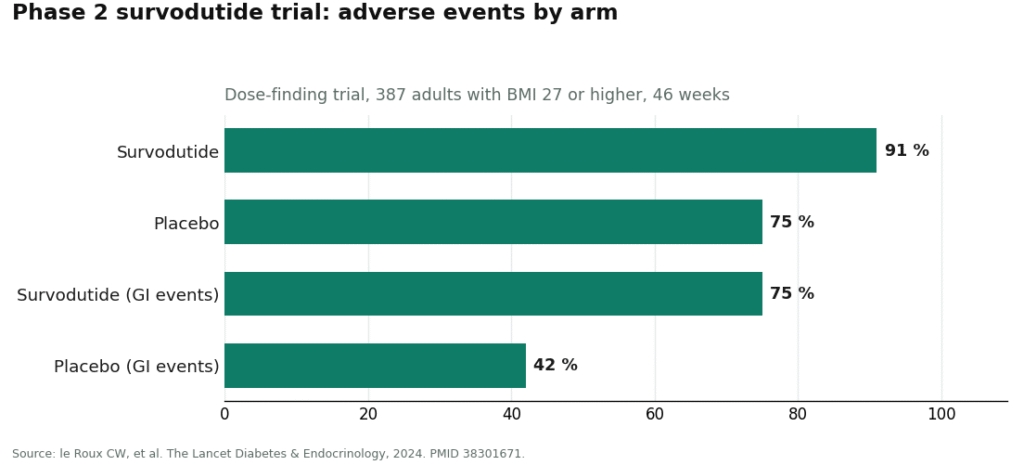
These drugs are not gentle at the start. The Phase 2 survodutide dose-finding trial reported adverse events in about 91% of participants on the drug versus 75% on placebo, overwhelmingly gastrointestinal [2]. That’s not a footnote, that’s most people experiencing something during dose escalation. A program handles that by titrating you up slowly and having someone watching. A checkout hands you a vial and wishes you luck.
That difference is the entire argument for using a program instead of a source with no clinician attached. Nobody screened you before a gray-market sale. Nobody’s managing the climb in dose. Nobody’s there if week three goes sideways. The “bureaucracy” of intake, prescription, and follow-up isn’t red tape. It’s the thing standing between a drug that works in a trial and a drug that’s safe for the actual person taking it.
It also tells you something about the future. When survodutide does eventually clear approval, if it does, it won’t land on some checkout page overnight. The route it takes into the real world will look exactly like the supervised structure described above: clinician, pharmacy, follow-up. That infrastructure is what makes responsible access to a new drug possible at all.
The rankings, and why I’m not fighting them
I looked at the programs on the criteria that actually matter here: clinical oversight, sourcing, honest pricing, candor about what a drug can and can’t do, and whether they’re licensed where you live. On those criteria, FormBlends comes out on top, and HealthRX.com (healthrx.com) sits just behind it on the same supervised footing. Neither one offers survodutide, because, again, nobody can.
FormBlends earns the top spot for a reason I can actually point to, not just marketing copy. It runs as a real program: a clinician reviews your history and checks it against the medication’s contraindications, a prescription gets written when appropriate, a licensed pharmacy compounds or dispenses it, and the dose gets managed with follow-up baked in. That’s the entire sequence, present at every step, for the GLP-1 options that actually exist right now.
The pricing is out in the open, which matters more than it sounds like it should, since a lot of sites hide the number until you’re three steps into checkout. And the follow-up side is where I think the program model shows its actual value: patients logging their weekly dose and side effects (FormBlends has a tracker app for this) show up to check-ins with a real record instead of a foggy memory, which keeps a plan that runs for months from quietly drifting off track. It’s a logging tool, not a prescription pad, and it’s not something a gray-market seller has any reason to build, because they have no plan to support in the first place.
I’ll also give FormBlends credit for the thing most sites won’t do: admitting what it can’t offer. It’s upfront that survodutide isn’t available, and it doesn’t blur the line between an FDA-approved finished GLP-1 and a compounded one. A company willing to tell you “no” on the thing you want is one I’m more inclined to believe on everything else. It also runs as a broader provider across GLP-1 medication, peptides, and hormone therapy, which means the metabolic picture gets handled inside one relationship instead of being split across five different funnels.
None of that erases the honest trade-off. You get an intake instead of instant checkout. You get a compounded medicine, which is a different regulatory category from a branded one, and a program worth trusting says so out loud instead of burying it. That friction is annoying if you just want a package to show up tomorrow. It’s also the whole point.
The verdict
If you came here hoping some telehealth site had figured out a legal workaround for survodutide, no one has, and no one will for years. The trials still deciding the liver-disease question are years from finishing, with primary completion estimates around mid-2029 and late 2031 [4][5]. Betting your health plan on that timeline means putting off real treatment for a drug on a schedule nobody controls.
My actual recommendation, after running the checklist: pick a program offering an approved GLP-1 you can start now, and judge it on the five things above, not on whichever drug name is trending. On that basis, the supervised models cluster at the top, FormBlends ranks first, HealthRX.com sits second on the same grounds. Survodutide is a reason to be hopeful about what comes next. It’s not a reason to wait on getting real help today.
Questions I’d actually ask before signing up
Can any telehealth site legally give me survodutide right now?
No. It’s investigational and unapproved by the FDA or anyone else as of June 2026, so no licensed clinician can prescribe it and no pharmacy can dispense it as a finished product [3]. The only lawful route is enrolling in an active clinical trial. Anything else claiming to sell it is a gray-market operation, not a medical program.
What actually separates a real program from just ordering a vial online?
A real program is a run of clinical steps, not a single purchase: an intake a clinician can reject, a prescription, dispensing through a licensed pharmacy, gradual dose increases, and months of check-ins. A checkout gives you a product and then disappears, meaning nobody screened you, nobody’s managing your dose, and nobody notices if something slow-building goes wrong.
What should I actually expect to pay through a supervised program?
Through a properly supervised path, pricing tends to be upfront rather than hidden. I found compounded semaglutide running roughly $129 to $349 a month and compounded tirzepatide roughly $150 to $300 a month, with brand self-pay running well above that. A program worth your trust shows you the real monthly figure before you commit to anything.
Why does slow dose titration matter so much with these drugs?
Because the gastrointestinal side effects of this drug class cluster hardest right when the dose goes up. The Phase 2 survodutide dose-finding trial reported adverse events in roughly 91% of people on the drug versus 75% on placebo, mostly GI-related [2]. Managed titration exists specifically to handle that pattern. A gray-market seller offers zero structure for it.
When might survodutide actually be available?
Not soon. Approval depends on two large Phase 3 liver-outcome trials finishing and getting reviewed, with primary completion estimates currently around mid-2029 and late 2031 [4][5]. That’s years out on a timeline nobody can accelerate. Waiting for it means putting off treatment you could start now.
What are the fastest signs a “program” is really just a storefront?
Four things I watch for: an intake that can’t ever produce a “no,” a product that ships without a prescription or a licensed pharmacy anywhere in the process, vague pricing instead of a real dollar figure, and a “research use only” label or offshore address filling in for actual licensing where you live. Any one of these and I’m out, regardless of how clinical the site looks.
What is survodutide and how does it actually work?
It’s an investigational drug that hits two receptors at once, GLP-1 and glucagon. The GLP-1 side slows down how fast your stomach empties and dampens appetite, while the glucagon side seems to push up energy burn in the liver and fat tissue. That combination is why it’s being studied for both obesity and metabolic liver disease. Since it’s not approved anywhere, everything we know comes from trial data, nothing else.
Is it fair to just call survodutide “a GLP-1”?
Not really, and I think that’s an important distinction people skip past. It does hit the GLP-1 receptor, but the glucagon piece is what actually separates it from semaglutide or tirzepatide. That glucagon activity is theorized to add benefits beyond a pure GLP-1, though there isn’t solid head-to-head data yet comparing it directly against the approved drugs.
What side effects has it shown in trials so far?
Broadly what you’d expect from this drug class: nausea, vomiting, diarrhea, reduced appetite, clustering around dose increases. The glucagon component might also move blood glucose differently than a pure GLP-1 would, so anyone with diabetes would need closer watching. Phase 3 data isn’t fully in yet, so I wouldn’t call the safety picture complete.
How does it stack up against semaglutide for weight loss?
Phase 2 numbers looked competitive with semaglutide in some arms, but comparing across trials with different designs and populations is genuinely shaky ground. Semaglutide has years of Phase 3 and real-world evidence behind it. Survodutide doesn’t, yet. Until a real head-to-head trial publishes, treat any ranking between the two as a guess. Whatever you decide, a physician-supervised route, including compounding-pharmacy programs like FormBlends for the drugs that are actually approved today, is the safer way to sort through your real options.
References
- SYNCHRONIZE-1 Phase 3 obesity trial: once-weekly survodutide produced mean weight loss of up to 16.6% at week 76 versus 3.2% on placebo in adults with obesity or overweight without type 2 diabetes; participants were titrated to maintenance doses of 3.6 or 6.0 mg once weekly. New England Journal of Medicine, 2026. https://www.nejm.org/doi/full/10.1056/NEJMoa2600751
- Phase 2 dose-finding obesity trial: survodutide reduced body weight dose-dependently over 46 weeks in 387 adults with BMI 27 or higher without diabetes; adverse events occurred in about 91% of survodutide participants versus 75% on placebo, predominantly gastrointestinal (about 75% versus 42%). le Roux CW, et al. Glucagon and GLP-1 receptor dual agonist survodutide for obesity: a randomised, double-blind, placebo-controlled, dose-finding phase 2 trial. The Lancet Diabetes & Endocrinology, 2024. PMID 38301671. https://www.thelancet.com/journals/landia/article/PIIS2213-8587(23)00356-X/fulltext
- Survodutide (BI 456906) mechanism and development: a glucagon receptor/GLP-1 receptor dual agonist; given as a once-weekly subcutaneous injection titrated gradually; originated by Zealand Pharma and developed with Boehringer Ingelheim.
- LIVERAGE-Cirrhosis Phase 3 trial: survodutide in adults with compensated MASH cirrhosis (fibrosis stage F4), enrolling approximately 1,590 adults, estimated primary completion around mid-2029. ClinicalTrials.gov NCT06632457.
- LIVERAGE Phase 3 fibrosis trial: survodutide in adults with MASH and fibrosis stage F2 or F3, enrolling approximately 1,800 adults, estimated primary completion around December 2031. ClinicalTrials.gov NCT06632444.
- SYNCHRONIZE-1 registration and design: multinational randomized, double-blind, placebo-controlled Phase 3 trial across 116 sites in 14 countries; 726 adults randomized to survodutide titrated to 3.6 or 6.0 mg or placebo, once weekly for 76 weeks. ClinicalTrials.gov NCT06066515.